


ROSA® Robotic System
.png)
-3.jpg)
As people age, the loss of bone and muscle often leads to severe joint pain, sometimes requiring knee replacement surgery. In public hospitals, the waiting time for such procedures is approximately four years (with 33,951 cases recorded as of June 30, 2024). For patients suffering from persistent pain, timely treatment options are crucial.
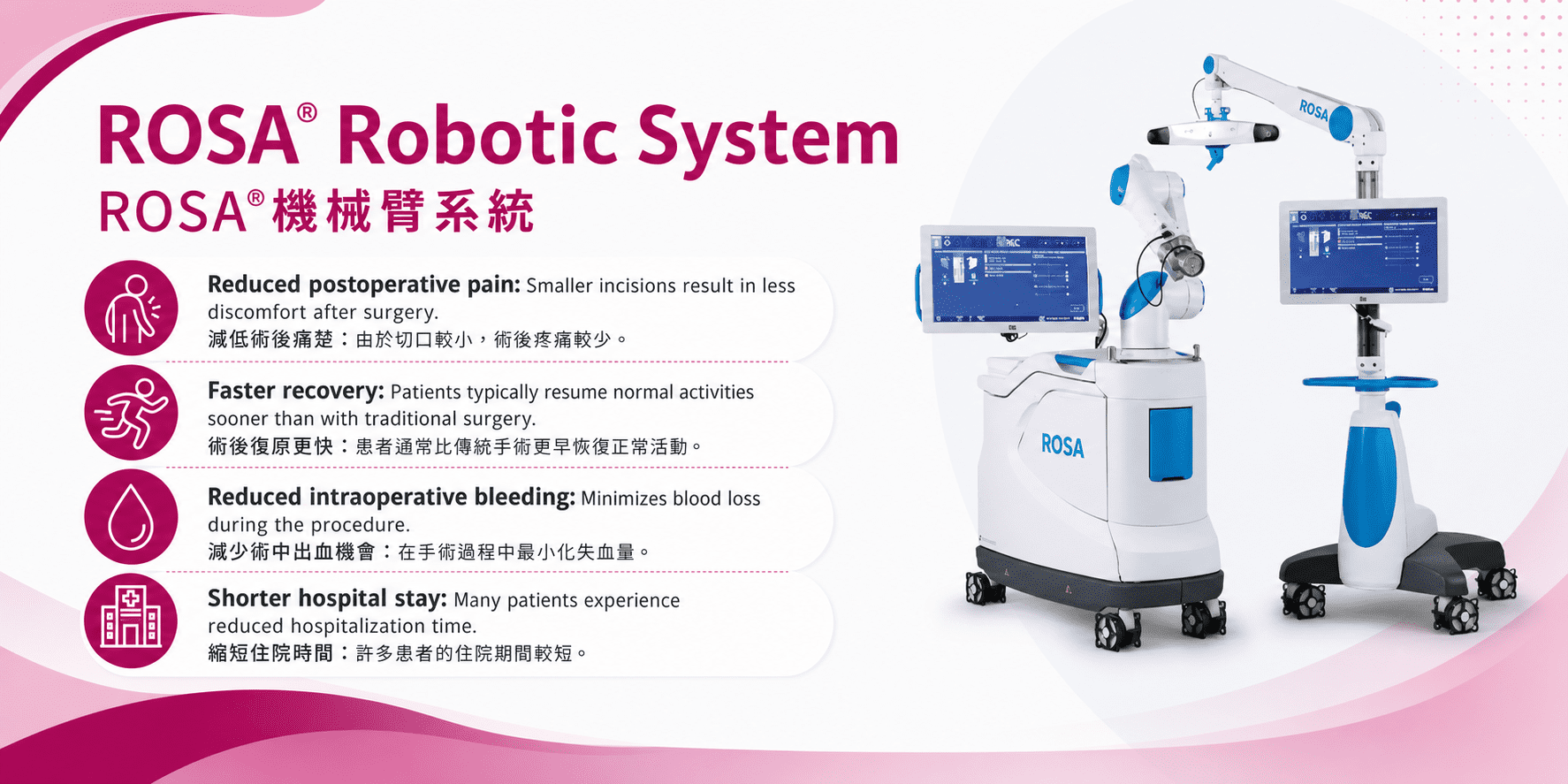
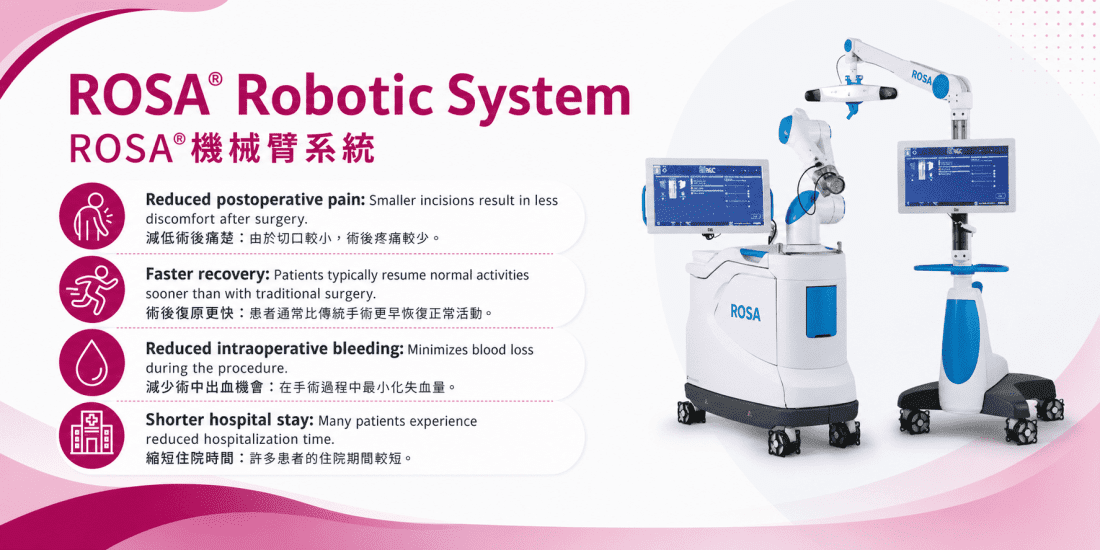
The ROSA® Robotic System is an advanced medical technology designed to assist orthopedic surgeons. Following professional diagnosis, the system helps surgeons perform highly precise bone cuts during surgery, ensuring optimal alignment between the artificial joint and the patient’s bone structure. With the stability provided by robotic assistance, soft tissue damage is minimized, postoperative pain is reduced, and patients can regain daily mobility more smoothly after surgery.
Advantages
Reduced postoperative pain: Smaller incisions result in less discomfort after surgery.
Faster recovery: Patients typically resume normal activities sooner than with traditional surgery.
Reduced intraoperative bleeding: Minimizes blood loss during the procedure.
Shorter hospital stay: Many patients experience reduced hospitalization time.
Knee Joint Degeneration
Once the knee develops a pathological condition, the joint space narrows, and the articular cartilage is worn down and damaged, leading to pain and even deformity. The common causes include osteoarthritis, rheumatoid arthritis, post-traumatic arthritis, and osteonecrosis etc.
If the joint disease becomes severe, and conservative treatment is ineffective, the orthopedist will select the most appropriate knee replacement based on the patient's knee joint condition. The affected bone is removed, and it is replaced with metal. The cartilage portion is substituted with high-molecular- weight polyethylene, eliminating the direct friction of the metal surfaces.
Advantages of Robotic-Assisted Total Knee Replacement
After the professional diagnosis and selection of the appropriate artificial joint for the patient, orthopedic surgeon will perform joint replacement surgery to implant the artificial joint to patient's body. The ROSA® Robotic System provides stable, precise, and highly reproducible cutting, which can help the orthopedic surgeon to perform the surgery more accurately. Moreover, robotic system allows adjustment and personalization of bone cut and artificial joint position, which effectively reduce soft tissue damage and promoting postoperative pain relief, thereby improving surgical outcomes.
- Decreases Postoperative Pain
- Helps in a Faster Return to Daily Life
- Reduces Complications/Blood Loss
- Shortens Hospital Stay
Robotic-Assisted Hip Replacement Surgery
Hip arthritis or hip joint disorders refer to symptoms caused by damage to the hip joint's cartilage and related structures due to degeneration, inflammation, trauma, or other causes. Patients may find daily activities such as walking, sitting, or standing difficult and painful, significantly impacting their quality of life. If medication or mobility aids fail to relieve pain effectively, orthopedic specialists may recommend hip replacement surgery to alleviate pain and help patients regain a normal lifestyle.
Understanding Total Hip Replacement Surgery
Total hip replacement surgery is a common orthopedic procedure. When the hip joint is severely damaged due to disease or injury, causing pain that cannot be managed with medication or non-surgical treatments, a surgeon may recommend this procedure. The damaged femoral head, acetabulum, and cartilage are removed and replaced with artificial joint components, commonly referred to as "total hip replacement".
Robotic-Assisted Hip Replacement Surgery
In recent years, Hong Kong has introduced robotic-assisted hip replacement surgery, combining traditional surgical techniques with modern technology to achieve greater precision and safety during the procedure.
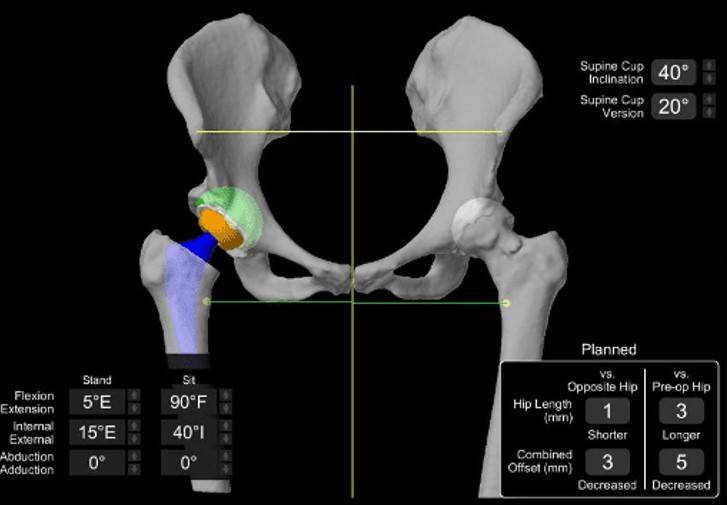
Before surgery, patients undergo a CT scan to create a preoperative 3D computer model. This allows surgeons to accurately plan the size and positioning of the acetabular and femoral components based on the patient’s specific anatomy.
During the procedure, the surgeon uses a robotic arm to perform precise grinding of the acetabulum, ensuring accurate bone preparation while minimizing trauma to surrounding soft tissues. The placement of the hip prosthesis is also guided by the robotic arm, allowing precise adjustments to clinical parameters such as leg length and offset, ensuring optimal positioning of the artificial joint.
Benefits of Robotic-Assisted Hip Replacement Surgery
- High Precision: International medical studies confirm that robotic-assisted techniques offer greater accuracy than traditional surgery. Postoperative X-rays show that the placement of the prosthesis in robotic-assisted surgeries is closer to the surgeon’s preoperative plan, reducing surgical errors.
- Enhanced Safety: Preoperative planning with CT scans allows surgeons to define the depth and boundaries of bone cutting. The robotic system, equipped with tactile control, minimizes errors during bone cutting, reducing damage to surrounding soft tissues and blood loss.
- Faster Recovery: Reduced soft tissue damage and blood loss lead to shorter recovery time for patient.
- Extended Prosthesis Lifespan: More precise positioning and alignment of the artificial joint contribute to a longer lifespan for the prosthesis.



.png)

Consultant In Orthopaedics & Traumatology

FHKCOS
FHKAM (Orthopaedic Surgery)
FRCSEd (Orth)
MRCSEd
Clinical Director Of Robotic Surgery (Joint Replacement) (HKAH-SR)

MRCSEd
FRCSEd (Orth)
FHKCOS
FHKAM (Orthopaedic Surgery)
Robotic Surgery (Joint Replacement)

MRCSEd
FRCSEd (Orth)
FHKCOS
FHKAM (Orthopaedic Surgery)

Consultant In Orthopaedics & Traumatology

DFM (HKCFP)
DCH (Irel)
MRCSEd
FRCSEd(Orth)
FHKAM (Orthopaedic Surgery)
FHKCOS

FRCSEd
FCSHK
FHKCOS
FHKAM (Orthopaedic Surgery)
FRACS
Consultant In Orthopaedics & Traumatology

FRCSEd (Orth)
FHKCOS
FHKAM (Orthopaedic Surgery)

MRCSEd
FRCSEd (Orth)
FHKCOS
FHKAM (Orthopaedic Surgery)
Robotic Surgery (Joint Replacement)

MRCSEd
FRCSEd (Orth)
FHKCOS
FHKAM (Orthopaedic Surgery)
Spine Surgery

M Med Sc (HK)
FRCSEd(Orth)
FHKCOS
FHKAM (Orthopaedic Surgery)





.png)